"Today’s Vedanta Share Price: Real Market Data, Analysis, and a Look Ahead")
Indian metal, mining, and resource investors pay a lot of attention to the Vedanta share price. Vedanta Limited is a large company that works in many different areas of natural resources, including metals, mining, oil and gas, and power. The Vedanta share price now is affected by both macroeconomic and company-specific factors, including as global commodities patterns, corporate restructuring, and a long history of dividends. Both short-term traders and long-term investors need to know why this price change happened.
Vedanta’s shares are now trading on the National Stock Exchange for around ₹614.35 to ₹616.95 per share. Recent price changes show how the market feels about the company and how its corporate strategy and performance have changed.

Current Market Snapshot: Vedanta Share Price Today
| Data Point | Value |
| Vedanta share price today (approx.) | ₹614.35 – ₹616.95 per share |
| Exchange | NSE & BSE |
| 52-Week High | ~₹618.45 |
| 52-Week Low | ~₹363.00 |
| Market Capitalization | ~₹2.41 lakh crore |
| Dividend Yield | ~7% to 8% historically |
| PE Ratio | Varies across markets (approx. 13–25 depending on source) |
The Vedanta share price today is trading near multi-year highs, having gained significantly in the last year and especially since corporate transformation news began influencing investor sentiment.
The price of Vedanta shares over time
The price of Vedanta shares has always been strongly tied to global commodities cycles. It has done well relative to other indices and metal sector peers over the past year, showing significant durability and upside.
- Vedanta reached all-time highs in late 2025, with prices between ₹580 and ₹620 after good news from the company.
- The stock has gone up because of news of structural changes, like the NCLT’s approval of its intention to split apart.
- Vedanta has given investors big returns over extended periods of time, especially those who held on through commodity upcycles.
This pattern shows that Vedanta has the capacity to grow quickly and strongly in good macroeconomic conditions.
The Rise in Vedanta Share Price Now
Approval for corporate restructuring and demerger
The National Company Law Tribunal (NCLT) approving the demerger plan was one of the key reasons for the rise in the price of Vedanta shares. This important decision has started Vedanta’s move into five independent public companies, which will help shareholders get more value and create development engines for each sector.
The areas that are expected to grow are aluminum, oil and gas, power, iron and steel, and the remaining Vedanta Ltd. company. This vision has made investors more confident and caused prices to rise sharply.
The momentum of commodity prices
The prices of metals and energy around the world have a big effect on Vedanta’s company. Strong prices for commodities like aluminum, zinc, and strategic minerals drive revenue and profits, which in turn supports the Vedanta share price. This is especially clear when there is a lot of metal production and export activity in important markets.
The strength and yield of dividends
Vedanta has always had good dividend yields, which is something that conservative investors looking for income like. Even though its rank among high-yield stocks has changed recently, dividend income is still a major support for the Vedanta share price, especially in sluggish or volatile markets.
Getting into important minerals
Recent strategic measures, such winning bids for important mineral blocks (like nickel and platinum group elements), have also helped raise long-term prospects for the Vedanta share price.
Recent news that affects the price of Vedanta shares
- The Financial Express: From LTIMindtree to L&T to Coal India to Vedanta — These are 10 equities to keep an eye on today.
- Vedanta Ltd’s share price hits an all-time high as the NCLT approves the demerger. Read the latest news, targets, and outlook (17 December 2025).
- Ad Hoc News Vedanta Ltd: The stock of the volatile metal giant is bouncing back from its lows, testing investors’ nerves.
- Vedanta is one of the most popular Indian stocks right now, which shows that there is a lot of interest in the Indian stock market.
- Record high after permission of demerger: Vedanta’s stock rose to new highs after the NCLT approved its revised demerger plan.
- Volatility and rebound: The Vedanta share price has been very volatile in recent sessions, even if it has bounced back from its lows. This shows that there are cyclical concerns.
These changes show how real-world market events have a direct effect on the Vedanta share price and investor sentiment.
Real-World Stock Data and Valuation Metrics
When looking at the Vedanta share price, investors look at a number of real metrics:
- Market Capitalization: More than ₹2.4 lakh crore, which makes it one of India’s top natural resources stocks.
- PE and Fundamentals: Different sources give different P/E ratios, but fundamental measurements reveal that Vedanta is trading in a range that many investors find attractive compared to its earnings potential.
- 52-Week Range: From around ₹363 to about ₹618, showing a lot of volatility and long-term growth.
- Dividend Yield: Historically high (about 7% or more during good times), which helps total returns.
- PE and Fundamentals: Different sources give different P/E ratios, but fundamental measurements reveal that Vedanta is trading in a range that many investors find attractive compared to its earnings potential.
Market Expectations and Predictions for the Vedanta Share Price
The real-world projection for the Vedanta share price is based on structural tendencies, not specific price levels, which might be misleading:
- Execution of the demerger and valuations: Finishing the multi-entity listing by early 2026 might make things more valuable.
- Commodity cycles: Earnings are projected to rise because there is still a lot of demand for metals and important minerals around the world.
- Operational performance: Growth potential is higher because of the expansion into aluminum, zinc, and new areas.
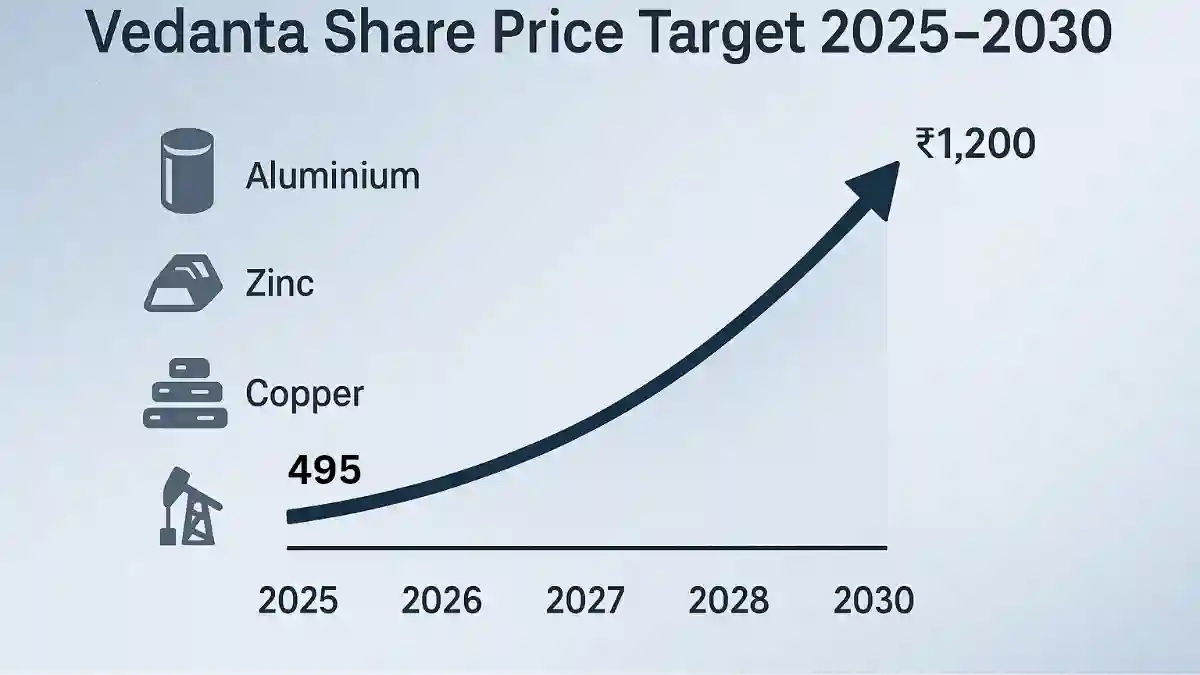
- Some brokerages have set analyst objectives. Nuvama has set a target of roughly ₹686 for the future, while Citi has kept its aim near ₹585.
These true objectives show that there is a moderate to strong chance of prices going up from where they are now.
Risks That Affect the Price of Vedanta Shares
The Vedanta share price, like all stocks in the real world, is at danger of many things:
- Commodity downturns: When demand is low around the world, revenue and profit can go down.
- Risk of a demerger going wrong: Delays or complicated structures could make people feel bad.
- Debt and leverage perceptions: Even while leverage has been controlled, worries about the structure of the parent company have sometimes affected prices.
- Volatility: Because Vedanta is a cyclical stock, its share price can change more quickly than those of defensive stocks.
Knowing about these risks helps investors come up with a balanced, real-world plan for how to deal with the Vedanta share price.
&format=webp&quality=medium)
Long-Term View on Investments
The Vedanta share price makes a case for long-term investors to buy it because of:
- Exposure to a variety of commodities in the metals and energy industries.
- The potential for dividend income to boost total returns.
- Corporate restructuring and efforts to unlock value, such the demerger.
- More general support from the rise of industry and the need for resources around the world.
These elements together suggest that, even if the Vedanta share price may be volatile from time to time, it could deliver good returns over the long term for investors who like cyclical and natural resource equities.
Comparing with Other Dividend and Metal Stocks
People typically compare Vedanta’s stock price to those of other companies in the metal and mining sector and to other high-dividend stocks. Vedanta’s dividend rating has faced competition from smaller firms lately, but its market cap and diversity still make it one of the most reliable income-plus-growth choices in the resources area.
Questions that people often ask about the Vedanta share price
What is the price of Vedanta shares today?
On the National Stock Exchange, the price of a Vedanta share today is between ₹614.35 and ₹616.95.
Why is the price of Vedanta shares going up?
The price of Vedanta shares has gone up since the NCLT approved the demerger plan, commodity prices are high, vital minerals are growing, and the dividends are high.
Does Vedanta give out dividends?
Yes, Vedanta has paid out strong dividends in the past, which is good for investors who want to make money and makes the Vedanta share price more appealing.
What are the main dangers that could affect the price of Vedanta shares?
Some of the biggest risks are fluctuations in the prices of goods, the danger of failing to carry out company reorganization, and changes in market sentiment caused by economic cycles.
mint
Is buying Vedanta shares a solid long-term investment?
The Vedanta share price can be a good long-term investment for people who are okay with volatility and want to get dividends and cyclical commodity exposure.
What price levels do analysts think Vedanta will reach in the future?
Brokerages such as Nuvama and Citi have set price goals of roughly ₹686 and ₹585, respectively, which shows that they think prices might go up from where they are now.
Conclusion
The price of Vedanta shares is still affected by the changing relationship between the metal and energy markets, corporate transformation efforts, and what investors expect. Vedanta’s growth story appeals to both dividend investors and cyclicals-focused portfolios now that the demerger process has been approved and commodity cycles are strong.
The Vedanta share price is still volatile in the near term, but its long-term prospects depend on having a variety of income streams, making strategic changes, and stable dividend support. Vedanta is still an essential stock to watch for investors who want to witness India’s resource sector expansion in action.
Read More:- Today’s Quality Power Share Price: A Look at the Real Market and Its Trends